
Wine Words Explained: Read a Label Without Feeling Daft

Key takeaways
- Most wine terms describe something you can taste, a fact on the label, or a habit at home.
- On Champagne and other EU-labelled fizz, Brut means dry. “Extra Dry” is sweeter than Brut.
- English wine is made from grapes grown in England. “British wine” is made in the UK from imported grape juice.
- Serve reds cooler than most living rooms: WSET puts wine’s “room temperature” at 15 to 18°C.
- Most wine is made to drink young.
- Experts argue over some words, like terroir and minerality. Others, like legs, are often misread. We flag them as we go.
Wine talk can feel like a club with a password. Here’s our own Kathleen Vintage Sparkling Rosé, condensed from her product page:
2018 vintage. Traditional method. 80% Seyval Blanc, 20% Pinot Noir. Lees aged in bottle for 49 months. Riddled and disgorged in March 2025.
If that reads like a ransom note, you’re in good company. By the end of this page, you’ll be able to read it line by line. The same goes for most labels, shelf cards and tasting sheets.
Fair warning: the people who teach some of these words still argue about them. We’ll tell you which ones, rather than pretend there’s one answer.
Jump to: The big five · Labels · Styles · Tasting · Aromas · Body · Acidity and tannins · Serving · Storing and cellaring · Winemaking
The big five: vintage, terroir, cuvée, varietal, Old World vs New World
These five words do the heavy lifting on labels and wine lists. Experts argue about two of them. And the Oxford Companion to Wine says a third is increasingly misused.
Vintage
The year the grapes were harvested.
On the label: in the UK and EU, at least 85% of the grapes must come from that year. Vintage Champagne is stricter: every grape must come from that year. Kathleen carries our 2018 vintage. As her page puts it, “some years are just too good to blend away.”
Non-vintage (NV)
A wine that doesn’t claim a single harvest year, so there’s no vintage on the label. It may be a blend of several years.
NV isn’t a lower grade. In Champagne, the non-vintage is the house’s signature wine. It blends several harvests to keep the house style consistent. Our Sparkling White is NV.
Terroir (say “tear-woh”)
How a vineyard’s surroundings show up in the wine: its soil, its climate, its slope and the way it faces.
Experts disagree: the Oxford Companion calls terroir “the total natural environment” of a vineyard. France’s appellation authority, INAO, goes further. It counts the know-how of the people who farm there too.
Treat terroir as an idea, not a measurement. Ours is rich clay soil and a cool climate that lets the grapes ripen slowly.
Cuvée
Usually a particular blend or batch of wine. Often it’s just the name on the bottle.
In Champagne it also means the first and best juice from the press, and a “prestige cuvée” is a house’s top wine. On most other labels, cuvée is a name, not a promise of quality.
Varietal (and variety)
A varietal wine is named after its main grape. A bottle labelled “Pinot Noir” is a varietal wine.
Used loosely: people often say “varietal” when they mean the grape (“my favourite varietal”). The Oxford Companion calls that a misuse. The grape is the variety. The wine is varietal.
On the label: in the UK and EU, a wine named after one grape must be at least 85% that grape. After an exceptional 2025 growing year, we were so pleased with our Acolon grapes that we gave them a bottle of their own. Find it among our varietal wines.
Blend
Wine made by mixing different grapes, vineyards, barrels or years.
Blending is how most great wine is made. The Oxford Companion points out that almost all of the world’s finest wines are blends, Champagne and sherry included. Our Eleanor Rosé is one: “Pinot Noir for softness and red fruit, Gamay for a juicy fresh lift, and Cabernet Franc for just enough structure to hold it all together.”
Old World vs New World
Old World means Europe and the Mediterranean. New World means wine countries beyond it, such as the USA, Australia and Chile.
Experts disagree: the labels are looking dated. In 2026, Decanter called the old stereotypes (restrained Old World, fruity New World) “simply obsolete”. It also said English wine is made with “entrepreneurial freedom more often associated with the New World”.
Old World address, New World attitude. In Yorkshire, we’ll take that.
Labels and classifications
Some label words are legal promises. Others are marketing in a smart jacket. And one phrase on UK shelves sounds home-grown, but the grapes aren’t.
Appellation (AOC, DOC, DOCG)
A protected place name for wine. It comes with rules about where the grapes grow and how the wine is made.
France calls it AOC. Italy and Portugal use DOC. Italy’s top tier is DOCG, which adds a lab test and a tasting panel.
An appellation tells you the rules were followed. It doesn’t promise you’ll like the wine.
PDO and PGI
The UK and EU names for protected wines. Here’s how they work in England:
- PDO (Protected Designation of Origin): the wine can call itself “English”. All of its grapes must be grown in England.
- PGI (Protected Geographical Indication): the wine is labelled “English Regional”. At least 85% of its grapes must be grown in England.
Wales has its own versions. Wines in both schemes must pass a lab test and a tasting test. A wine outside the schemes isn’t necessarily worse. It just hasn’t been through them.
British wine
Not what it sounds like. “British wine” is made in the UK, but from imported grape juice, not from grapes grown here.
The industry’s own code asks for the words “made from imported grape juice”, or similar, on the label. WineGB, which represents UK growers, wants the name kept for wine made from British-grown grapes.
In the shop: for home-grown wine, look for “English” or “Welsh”. We grow, harvest, ferment and bottle all of ours at Nun Monkton.
Reserve, Reserva, Riserva
A word that suggests a better or longer-aged wine.
In some countries it’s a legal promise. A red Rioja Reserva, for example, must age for at least three years, with at least one of them in oak barrel. Portugal and Italy have their own rules too. In countries with no rules, Decanter calls these words “undefined and thus meaningless”. We found no UK definition.
Grand cru and premier cru
French for “great growth” and “first growth”. They mean different things in different regions.
In Burgundy, a grand cru is one of a few especially favoured vineyards, a notch above premier cru. In Champagne, the terms rank villages. In Bordeaux, they usually belong to a château. Either way, they rank the place, not the bottle in your hand.
Claret
The traditional British name for red Bordeaux.
ABV
Alcohol by volume: how much of the wine is alcohol, shown as “% vol”. Our Latimer White is 11%, and our fortified Solara is 18%.
Contains sulphites
UK labels must carry this warning when a wine has more than 10 milligrams of sulphites per litre. Sulphites occur naturally in wine. Winemakers also add some to keep wine fresh.
Worth knowing: sulphites often get the blame for wine headaches. But red wine, the usual suspect, generally has less sulphite than white or rosé, says Allergy UK. Scientists are still working out why some people get headaches from wine. Some people are genuinely sensitive to sulphites: Allergy UK says around 1 in 10 people with asthma may react.
Wine styles
These words tell you what’s in the bottle before you pull the cork. One of them works back to front.
Dry
Not sweet: there’s little or no sugar left in the wine.
On the label: on a UK still-wine label, “dry” means no more than 4 grams of sugar per litre. If the wine is acidic enough, it can go up to 9. Fizz plays by different rules: see Brut. Our Seyval Blanc is “unashamedly dry, crisp, and invigorating”.
Off-dry
Slightly sweet. There’s enough sugar to soften the edges, but not enough to call it sweet.
Used loosely: off-dry is a tasting word, not a legal term. On a UK label, you’ll see “medium dry” instead. Our Latimer Rosé is “off-dry (meaning it’s not bone dry), so it feels softer on the palate”.
Sweet and dessert wine
On a UK still-wine label, “sweet” means at least 45 grams of sugar per litre. “Dessert wine” is an everyday name for sweet wines served with pudding, or as pudding.
Fortified wine
Wine with spirit added, usually grape spirit. This lifts the strength to between 15% and 22%. Port and sherry are the best known. The official name is “liqueur wine”.
The earlier the spirit goes in during fermentation, the sweeter the wine. Our Solara is our Solaris white wine, fortified with our own brandy and then aged in barrel.
Brut (and the fizz sweetness scale)
On Champagne and other EU-labelled fizz, Brut means dry: under 12 grams of sugar per litre. On the same scale, “Extra Dry” is sweeter than Brut, and “Dry” is sweeter still.
| On the label | Sugar per litre |
|---|---|
| Brut Nature (Pas Dosé, Dosage Zéro) | under 3g, no sugar added after the second fermentation |
| Extra Brut | 0 to 6g |
| Brut | under 12g |
| Extra Dry | 12 to 17g |
| Sec (Dry) | 17 to 32g |
| Demi-Sec | 32 to 50g |
| Doux | over 50g |
These are EU and Champagne rules. The UK rulebook lists only English terms (extra dry, dry, medium dry and sweet), so British fizz may label itself differently.
In the shop: if your guest likes it properly dry, Brut is the safe bet. Browse our English sparkling wines.
Traditional method
Fizz made the Champagne way. The bubbles come from a second fermentation inside the bottle. The wine then rests on the spent yeast for at least nine months before the yeast is removed.
You’ll also see it called “méthode champenoise” or “classic method”. Crémant is a protected name for traditional-method fizz from certain regions, like Crémant de Bourgogne.
In the shop: in England, fizz with a protected name can be made in the bottle or in a tank. So WineGB created a “Great British Classic Method” mark for bottles made the traditional way. Every one of our sparkling wines is made this way.
Tank method (Charmat)
The second fermentation happens in a big pressurised tank, not in each bottle. The wine is then filtered and bottled. Most Prosecco is made this way. Expect fresher, fruitier fizz, with fewer toasty notes.
Pét-nat
Short for pétillant naturel. It’s gently sparkling wine that’s bottled before its first fermentation has finished, which traps the bubbles. It’s often a little sweet and a little cloudy, with some sediment. That’s normal for the style.
Blanc de blancs and blanc de noirs
Blanc de blancs is white fizz made only from white grapes. Blanc de noirs is white fizz made only from dark-skinned grapes. In Champagne, that usually means Chardonnay for the first, and Pinot Noir and/or Meunier for the second.
Why is blanc de noirs still pale? A grape’s colour is in its skin, and the juice doesn’t stay with the skins long enough to pick it up.
Rosé
Pink wine. It’s usually made by leaving the juice with dark grape skins for a short time.
In the EU, still rosé without a protected name can’t be made by mixing white and red wine. Rosé Champagne is the exception. England dropped that rule in 2024.
Orange wine (skin contact)
White wine made like a red. The juice ferments with the grape skins, which gives it an amber colour, more texture and a little grip.
Used loosely: it’s also called skin-contact or amber wine. Strictly, though, “skin contact” can also mean a short soak before fermentation. For our Solaris Orange, “we leave the grape skins on during fermentation, the same way you’d make a red”. It was named best orange wine in competition at the 2024 WineGB Midlands & North awards. There’s more in our beginner’s guide to orange wine.
Natural wine
Wine made with as little interference as possible. That usually means hand-picked grapes from organic or biodynamic vineyards, wild yeasts, and few or no additives.
Used loosely: it sounds like a rule, but the UK has no legal definition. France has a voluntary certified label called Vin Méthode Nature.
Organic and biodynamic
Organic wine comes from organically grown grapes. It’s made under organic rules, which set lower limits on added sulphites. So organic doesn’t mean sulphite-free.
Biodynamic farming builds on organic farming with its own preparations and calendar. It’s certified by private bodies.
Experts disagree: the Oxford Companion calls biodynamics “controversial”. It says the approach has “produced some impressive results”, but without a conclusive scientific explanation.
Vegan wine
Wine made without animal products. This usually comes down to fining, a way of clearing the wine. Some winemakers fine with egg white, milk protein, gelatine or isinglass (from fish).
In the shop: labels won’t always tell you. Egg and milk only have to be listed if more than a tiny trace remains. Look for a clear vegan statement.
Tasting terms
Most tasting words are ordinary words used precisely. For the how-to (look, swirl, smell, sip), see our guide to what to expect from a wine tasting.
Nose (aroma, bouquet)
The wine’s smell, and the act of smelling it.
Used loosely: “aroma” usually means the simpler smells of grapes and young wine. “Bouquet” means the more complex smells that come with age. The Oxford Companion notes there’s little agreement on where one ends and the other begins.
Palate
How a wine tastes and feels in your mouth. It’s also a taster’s skill, as in “she’s got a good palate”. The Oxford Companion notes it’s often misspelt. A pallet is for forklifts.
Finish
How long the flavour lingers after you swallow. A long finish is generally a good sign.
Legs
The streaks that run down the inside of the glass after you swirl. They mostly tell you about alcohol. As Decanter puts it, legs “tell you relatively little about the wine, and nothing about the quality of what’s in the glass”.
Often misread: alcohol isn’t the whole story. Decanter says sugar and tannin can help legs form. Glycerol, often blamed, plays no part, says the Oxford Companion. And some fine German wines at just 7 or 8% alcohol still form very obvious legs.
Balance (and structure)
When the fruit, acidity, sweetness, alcohol and tannin sit in proportion, and nothing sticks out. Decanter calls balance the thing that decides a wine’s quality, though judging it is personal.
Structure is the frame those non-fruit parts build. People use the word in slightly different ways.
Oaked vs oaky
“Oaked” means the wine spent time in contact with oak, usually in barrels. That can add vanilla and toast. “Oaky” usually means too much of it: more wood than fruit.
Our Winemaker’s Choice White is oak-matured: “You’ll find vanilla and light toast from the barrel alongside ripe stone fruit.”
Minerality
Ever seen a wine described as tasting of wet stones, flint or chalk? That’s minerality. You’ll mostly meet it in cool-climate whites.
Experts disagree: nobody quite agrees what it is. The Oxford Companion calls it an “imprecise tasting term”, and says there’s even less agreement on where it comes from. Wine Folly even reports research suggesting most of those stony smells come from sulphur compounds made during fermentation.
We’re in this argument too. Our Seyval Blanc’s tasting notes say “Mineral”, for its flinty finish.
Aromas and flavours
Why can a sparkling wine smell of toast or biscuit when there’s no bread anywhere near it? The answer is in where wine’s smells come from.
Primary, secondary and tertiary aromas
WSET sorts wine smells into three families:
| Family | Where it comes from | What it can smell of | Think of |
|---|---|---|---|
| Primary | The grape itself, and the first fermentation | Fruit, flowers, herbs | A fruit bowl or a flower bed |
| Secondary | Winemaking after fermentation | Biscuit and bread (from yeast), butter (from malolactic), vanilla and toast (from oak) | A bakery or a butter dish |
| Tertiary | Time, as the wine matures | Dried fruit, honey, nuts, earth, mushroom | A larder of dried fruit, honey and nuts |
Our Ortega shows off the first family. It’s “famous for its incredible aroma, think peaches, blossom, and a hint of spice.” Our oak-matured Winemaker’s Choice White adds the second, with vanilla and light toast from the barrel.
Used loosely: an older way of sorting, common in Burgundy, puts fermentation smells under secondary instead.
Fruity and jammy
“Fruity” means fruit leads the way. “Jammy” means the fruit tastes cooked or very ripe, a bit like jam. WSET files it with cooked and dried fruit.
In the glass: fruity isn’t the same as sweet. Fruit is a flavour; sweetness is sugar. A wine can have either one without the other. Our Seyval Blanc tastes of green apple and lemon zest, and it’s still “unashamedly dry”.
Buttery
A smell and taste of butter. It mainly comes from a compound called diacetyl, made during malolactic conversion. That’s a natural softening step, usually after fermentation, where bacteria swap the wine’s sharp, green-apple acid for a softer one. There’s more under Winemaking below. Think of a classic buttery Chardonnay.
Malolactic doesn’t always mean buttery, though. Winemakers can turn the butter up or down.
Toasty and biscuity
In traditional-method fizz, the wine rests in the bottle on its spent yeast, called the lees. As the yeast breaks down, it gives bread, biscuit and toast notes.
The longer the wine rests, the stronger this tends to be. The Oxford Companion says the effect is small under about 18 months, and greatest after five years or more. Kathleen spent 49 months on her lees. It gives her that “rich, creamy ‘toasted’ flavour that only comes from proper bottle aging”.
Body and texture
Same glassful, so why does one wine feel heavier than another?
Body (light, medium, full)
How heavy or full a wine feels in your mouth. Think of milk (weird one I know, but stick with me here). Skimmed, semi-skimmed and whole are all milk, but each feels different. Wine body works the same way.
- Light-bodied wine is the skimmed milk: thin, quick and refreshing. Our Seyval Blanc and Latimer White sit at the light end of our scale.
- Medium-bodied wine is the semi-skimmed: rounder, but not heavy. Our Sparkling White and Winemaker’s Choice White sit in the middle.
- Full-bodied wine is the whole milk: it coats your mouth and stays there. Our Acolon is our fullest-bodied red.
What makes the difference? Mostly alcohol, which is thicker than water, says the Oxford Companion. But other things dissolved in the wine add weight too, such as sugar, acids and tannins. Winemakers call these “extract”, and reds usually have more of it than whites. That’s why the ABV is only a clue. Our Acolon is full-bodied at just 11%.
In the shop: most of our product pages show a Light to Full scale, so you can check before you buy.
Smooth
A friendly word for a wine with no rough edges. The Oxford Companion calls it an “imprecise term for pleasing texture”.
Used loosely: it means different things to different people, so ask what they mean. We use it ourselves. Our Acolon’s page calls it “Dry, smooth and fruit forward”.
Mousse
The feel of a sparkling wine’s bubbles in your mouth. WSET describes it as delicate, creamy or aggressive. Our Sparkling White “has a fine mousse (that’s wine-speak for bubbles) that feels creamy, not aggressive.”
Acidity and tannins
Why do cool-climate wines like ours tend to make your mouth water?
Acidity (and crisp)
The tangy part of a wine that makes it taste fresh. WSET has a simple test: “The more your mouth waters, and the longer it waters, the higher the level of acidity in the wine.”
Climate makes the biggest difference. As grapes ripen in the warmth, the vine uses up some of their sharp malic acid. So grapes from cooler places keep more of it.
“Crisp” means just this. The Oxford Companion defines it as “attractively high in acidity”. Our cool climate ripens grapes slowly, which is part of why our Latimer White is “crisp, dry, and zesty”.
Tannin (tannic)
The drying, grippy feeling on your gums, a bit like strong black tea. It comes from grape skins, seeds and stems, and from oak barrels.
You’ll find it mostly in reds, because red wine ferments with its skins. Skin-contact and oak-aged whites can have some too. Our Latimer Red is at the gentle end. Its tannins “are low, making this the most approachable red we make.”
Residual sugar
The grape sugar left in the wine after fermentation. Not all of it tastes sweet. Acidity, tannin, bubbles and temperature all change how sweet a wine seems.
Serving
“Serve reds at room temperature.” Good advice, until you hear what WSET means by it.
Serving temperature (and chilling reds)
WSET puts “room temperature for wines” at 15 to 18°C. That’s cooler than the 20°C or so most of us mean. In WSET’s words, it “might leave you reaching for a sweatshirt”.
As a rough guide:
- Champagne: 8 to 10°C (Comité Champagne).
- Oaked whites: 10 to 13°C (WSET).
- Lighter whites, rosés and other fizz: a little colder than oaked whites, but not below 6°C, where the cold hides the flavour (WSET).
- Light, low-tannin reds: slightly chilled, around 12 to 13°C (Decanter).
As our L.F.R. Light Fruity Red’s page admits, “We know, chilling a red sounds wrong.”
Decanting
Pouring wine into another container. People do it to leave sediment behind, or to give the wine some air.
Experts disagree: decanting works for sediment. But most everyday wines are filtered, so WSET says you’ll rarely need to. Decanting for air is what WSET calls a “traditional but disputed” reason. Some experts argue too much air dulls a wine.
Letting it breathe
Opening a bottle early so it can “breathe”. The Oxford Companion says the effect is “negligible”, because so little wine touches the air in the neck of the bottle. Swirling it in the glass, or decanting, does far more.
How long an opened bottle lasts
Wine does go off once it’s open. Air flattens it, and in time it turns to vinegar. With the stopper back in, Wine Folly suggests:
- Sparkling: 1 to 3 days in the fridge, with a sparkling-wine stopper. The Comité Champagne says one or two days for Champagne.
- Light whites and rosés: 5 to 7 days in the fridge.
- Fuller whites: 3 to 5 days in the fridge.
- Reds: 3 to 5 days somewhere cool and dark.
- Fortified wines: about four weeks.
These are guides to flavour, not food safety.
Storing and cellaring
Should you be saving that bottle for best? Possibly not.
Storing wine
Keep it cool, dark and steady. WSET and the Oxford Companion suggest 10 to 15°C for long-term storage. Don’t leave bottles in the fridge for months, either. WSET says corks can harden there.
Experts disagree: on its side or standing up? WSET says lay bottles with corks on their side, because upright corks can crumble and let air in. The Comité Champagne says it makes no difference for Champagne. Screwcap bottles can stand up.
Cellaring (laying down)
Keeping bottles so they mature and change. Only some wines improve: the ones with plenty of acidity, tannin, sugar or concentration. Most wine is made to enjoy young. And screwcap wines can age too. WSET calls the opposite “a common myth”.
Worth knowing: our Sparkling Rosé is made “to be drunk, not stored”. Kathleen spent years on her lees, but that ageing happened at the winery before release. It isn’t an instruction for your cupboard.
Winemaking
There’s a proper word for a bottle that smells musty instead of fruity. It’s the last entry in this section. For the whole process, see Vine to Wine: the winemaking process.
Fermentation
Yeast eating the sugar in grape juice and turning it into alcohol and carbon dioxide. For our Solaris Natural, “We allow the wild yeasts found naturally on the grape skins to kickstart the fermentation.”
Malolactic
A natural softening step. Usually after the main fermentation, and sometimes during it, bacteria turn the wine’s sharp malic acid (the tang in green apples) into softer lactic acid. People often call it malolactic fermentation, but the Oxford Companion points out it isn’t strictly a fermentation.
It makes wine taste softer and can add buttery notes. WSET says winemakers who want a fresh, crisp white often stop it happening.
Lees (sur lie)
The sediment of spent yeast left after fermentation. Leaving wine “sur lie”, or on its lees, adds flavour and texture. Traditional-method fizz must spend at least nine months on its lees. Kathleen had 49 months in bottle.
Riddling and disgorging
Riddling means turning and tilting the bottles, a little at a time, until the yeast sediment slides into the neck. Disgorging means removing that plug of sediment before the bottle is finished and corked. These days, riddling is usually done by machine, says the Comité Champagne.
Dosage
A small dose of sugar dissolved in wine. It’s added to traditional-method fizz after disgorging. It decides where the wine lands on the sweetness scale, from Brut Nature (no sugar added at this stage) upwards.
Fining and filtration
Two ways of clearing wine. Fining means adding something, such as clay, egg white or pea protein, that grabs the haze so it can settle out. Filtering strains the wine through a filter. Unfined, unfiltered wine can look a little hazy. Some winemakers prefer it that way.
Chaptalisation
Adding sugar to grape juice before or during fermentation. It raises the alcohol, not the sweetness, because the yeast ferments the sugar away. It’s legal, and common in cool winegrowing regions, England included.
Tartrate crystals
Glassy crystals on the cork or at the bottom of the bottle. They’re harmless tartrates, made from the grape’s own tartaric acid, and they often appear after a spell in the cold. Some people call them wine diamonds.
Corked (and oxidised)
A wine spoiled by a musty taint. It’s usually caused by a compound called TCA from a contaminated cork. It has nothing to do with bits of cork floating in your glass. Estimates of how often it happens run from about 1% to 5% of cork-sealed bottles. If a wine smells musty and the fruit has gone flat, take it back.
Oxidised is the other common fault. The wine has had too much air. It looks dull or brownish, and smells of bruised apples or sherry. In some styles, like certain sherries, that’s done on purpose.
Back to that bottle
Here’s Kathleen again:
2018 vintage. Traditional method. 80% Seyval Blanc, 20% Pinot Noir. Lees aged in bottle for 49 months. Riddled and disgorged in March 2025.
In plain English: the grapes were picked in the 2018 harvest. The bubbles were made in the bottle. She’s a blend of two grape varieties: Seyval Blanc, a white grape, and Pinot Noir, a dark-skinned one. She rested on her spent yeast for just over four years, which is where those toasty notes come from. Then the yeast was coaxed into the neck and removed in March 2025.
Gillian, who makes her, puts it like this:
“Named after my mum, Kathleen. We wanted a sparkling wine that had real character, something that lingers on the palate. The bottle aging gives it those lovely biscuit notes that sit perfectly underneath the fresh summer fruit.”
Gillian Spakouskas, Co-Owner, Yorkshire Heart
Palate, bottle ageing, biscuit notes: you know them all now. As for the words experts still argue about, like terroir and minerality, you know what the arguments are. So you’re entitled to an opinion of your own.
To put the words to the test, Kathleen is a good place to start. Or come and taste them with us. Our vineyard tours and tastings put the wine in your glass and the vines in front of you.
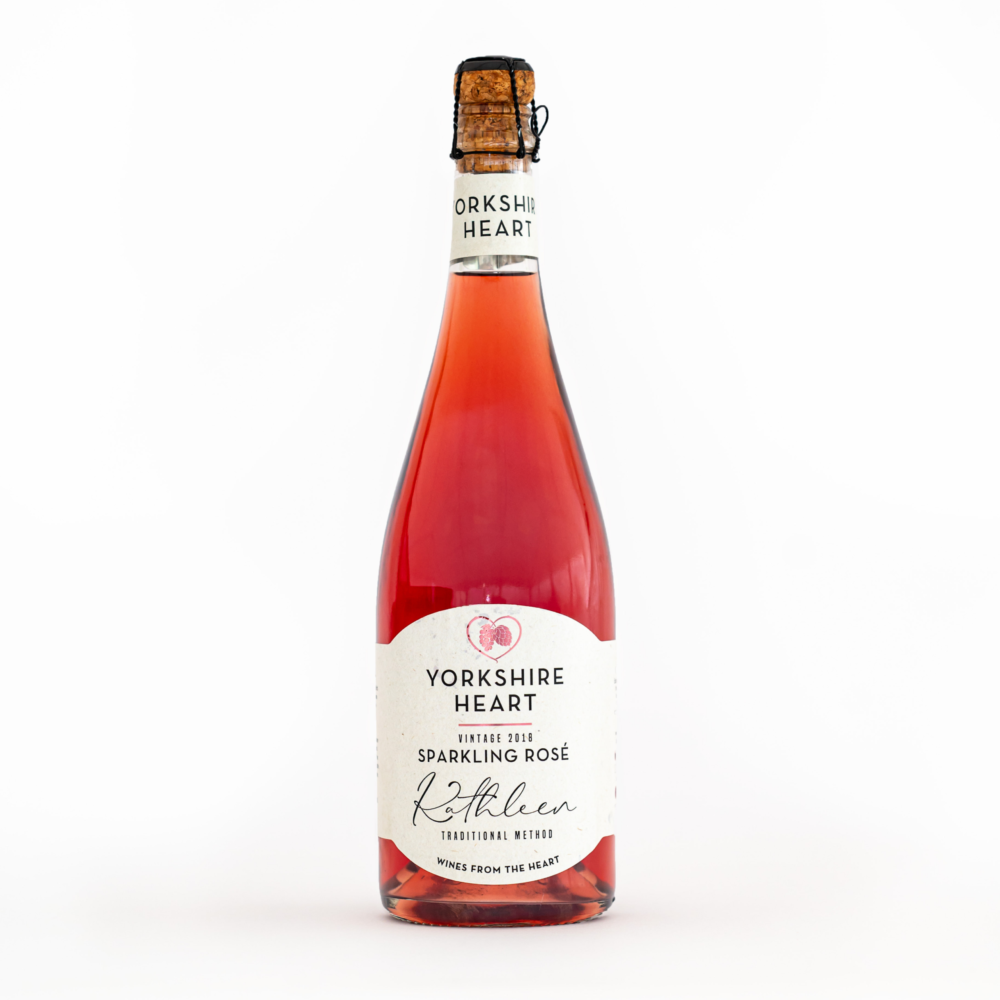
Kathleen Vintage Sparkling Rosé
Please raise a glass of our first ever vintage sparkling wine to remember Kathleen - Gillian's Mum.
Our first vintage sparkling rosé is made from 80% seyval blanc grapes and 20% Pinot Noir added at fermentation which gives the wine a luxurious pink colour with refreshing summer fruit flavours and raspberry & cherry notes. Our sparkling wines are made in the traditional method of second fermentation in the bottle.
The grapes for this wine were harvested in the great summer of 2018, the wine had 28 months tank lees aging before being bottled. It then spent 49 months bottle lees aging, before being degorged in March 2025 to create this stunning vintage sparkling wine.
2025 Awards: Members Choice, WineGB Midlands and North.
Size - 750ml
Alcohol content - 11.0%

Sign up for news and special offers
Subscribe to our newsletter to be the first to hear about exciting news, updates, events and receive exclusive offers.