
English Wine vs French Wine: An Honest Comparison


English wine and French wine are both excellent, but they are excellent at different things. France makes the world’s most varied and prestigious still wines. England, and increasingly the north of it, makes some of the world’s finest sparkling. That is the short answer.
The longer one is more interesting. In 2023, Chapel Down took its best-selling Brut to the heart of the Champagne region, disguised it under a French name, and ran a blind tasting. Sixty per cent of French drinkers preferred the English wine to a leading Champagne. In 2025, at the London Wine Fair, two English sparkling wines outscored prestige cuvées from Dom Pérignon, Krug and Bollinger in a blind tasting judged by Masters of Wine.
We grow grapes in Yorkshire, so yes, we have a horse in this race. But we love good French wine too, and the data does most of the talking here. Below, we look at where each country wins, where the gap has closed, and where it has quietly reversed.
A quick verdict, up front
Both English and French wine are very good, but they win in different categories. France makes the world’s most famous and varied still wines, with centuries of regional identity behind them. England, particularly the south and now increasingly the north, makes some of the world’s best sparkling wines, with a fresher, zestier character than most Champagne. For aromatic dry whites, cool-climate drinkers now have genuine English options worth seeking out. For full-bodied reds, France still wins comfortably, and it isn’t close.
Here is the comparison at a glance:
| Category | Where France wins | Where England wins |
|---|---|---|
| Sparkling | Depth, prestige, ageing | Freshness, acidity, value |
| Aromatic whites | Loire and Alsace heritage | Bacchus, Solaris, a modern style |
| Reds (light) | Burgundian Pinot Noir | Catching up fast |
| Reds (full-bodied) | Bordeaux, Rhône, decades ahead | Still developing |
| Rosé | Provence dominance | Sparkling rosés punching above their weight |
| Value | Mid-range workhorses | Direct-from-producer pricing |
A brief history (the bit most people don’t know)
Vines have grown in Britain for a very long time. The Romans planted them here, though wine never took hold at scale, and by the medieval period English wine was widespread, much of it made in monasteries.
Then comes the fact that surprises people most. In 1662, the English physician Christopher Merret presented a paper to the Royal Society describing how adding sugar and yeast to wine in a sealed bottle produces a sparkling wine. That was around thirty years before Dom Pérignon began his work at the Abbey of Hautvillers. There is a second English contribution too: our coal-fired glass furnaces produced bottles strong enough to hold the pressure of a second fermentation, which the wood-fired French furnaces of the day could not. Champagne, in other words, owes England a quiet debt.
A cooler stretch of climate and the spectacular rise of Champagne in France pushed English wine into the background for centuries. The modern revival began in the 1950s and 60s, then stepped up sharply from around 1990. Today the picture has changed completely. The WineGB Industry Report 2025 records more than 1,100 registered vineyards and a sector now valued at around £14 billion.
Climate, geology, and why it actually matters
Most of the difference between English and French wine comes down to where the grapes grow.
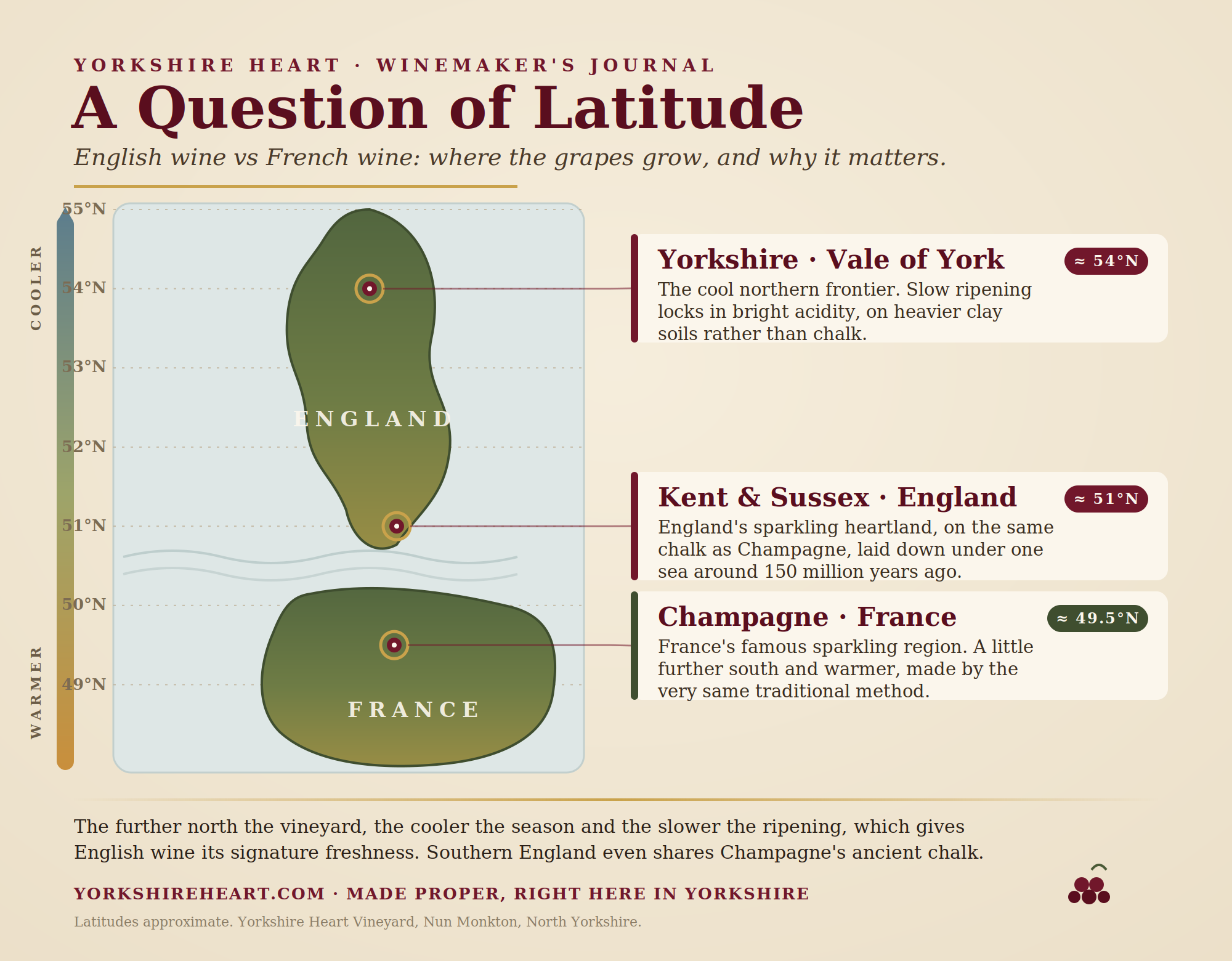
Latitude. Champagne sits at about 49.5°N. The main English wine regions sit at roughly 50 to 51°N. Our vineyard near Nun Monkton, in the Vale of York, sits at around 53 to 54°N, which is close to the northern frontier for growing wine grapes at all. That sounds like a disadvantage. In a warming climate, it has quietly become an asset.
Shared chalk. Parts of southern England share the very same chalk and limestone soils as Champagne. Around 150 million years ago, both lay under the same shallow sea. Chalk is a gift to a vine: it holds water in a dry year and drains it away in a wet one. This is part of why Kent and Sussex make sparkling wine that tastes so close to Champagne in structure. (This is the simplest way to think about terroir, the combination of soil, climate and place that shapes how a wine tastes.)
Yorkshire’s different story. Up here, we sit on heavier clay rather than chalk, in a cooler spot than the south. The grapes ripen slowly, which locks in acidity and concentrates flavour. It is a different recipe from Kent, but it draws on the same fundamental cool-climate advantage that gives English wine its freshness.
Climate change as a quiet accelerator. Europe has warmed by roughly 2°C over the past century, and the consequences split sharply by region. In Champagne, recent hot, drought-affected years have cost some growers a significant share of their crop. In England, the same trend has moved us from “can we ripen these grapes at all?” to “we can now make wines that compete at the very top.” One trend, two very different outcomes.
Sparkling wine: the headline event
This is where the comparison gets genuinely exciting, because the two wines are made the same way.
Both Champagne and good English sparkling use the traditional method (you may see it written as Méthode Champenoise or Méthode Traditionnelle). It simply means the second fermentation, the one that creates the bubbles, happens inside the bottle. The grapes are often the same too: Chardonnay, Pinot Noir and Pinot Meunier.
So where does the difference come from? Mostly style. English sparkling tends to be fresher and zestier, with brighter acidity, a product of our cooler growing season. Champagne tends to be richer, with more of that bready, biscuity, brioche character. That flavour has a name, autolytic, and it develops while the wine rests on its spent yeast (the lees) for a long time. Neither style is better. They are different pleasures.
There is a structural difference worth knowing too. Most English sparkling is made by the same people who grow the grapes, which keeps quality tightly controlled from vine to bottle. Champagne historically separates the growers from the great houses, and growers have often been paid by tonnage, which can pull towards quantity.
Then there is the evidence. The 2023 Chapel Down result is well known by now: 60 per cent of French drinkers, blind, preferred an English Brut to Champagne. More striking was the 2025 Battle of the Bubbles at the London Wine Fair, where sixteen judges including Masters of Wine tasted thirteen Champagnes against premium sparkling wines from around the world. The two highest-scoring wines of the whole tasting were English: Nyetimber’s 1086 and Gusbourne’s 51 Degrees North, placed ahead of Dom Pérignon, Comtes de Champagne, Krug and Bollinger R.D.
Here is the honest footnote, and it matters. Across the full line-up, Champagne remained the strongest category overall. England took the top two individual places, not a clean sweep. That is still a remarkable result for a country that, a generation ago, was treated as a weather joke.
One myth to retire: English sparkling is not cheap. The best of it sells for £40 to £200 a bottle. The value argument is “you get what you pay for,” not “we undercut them.”
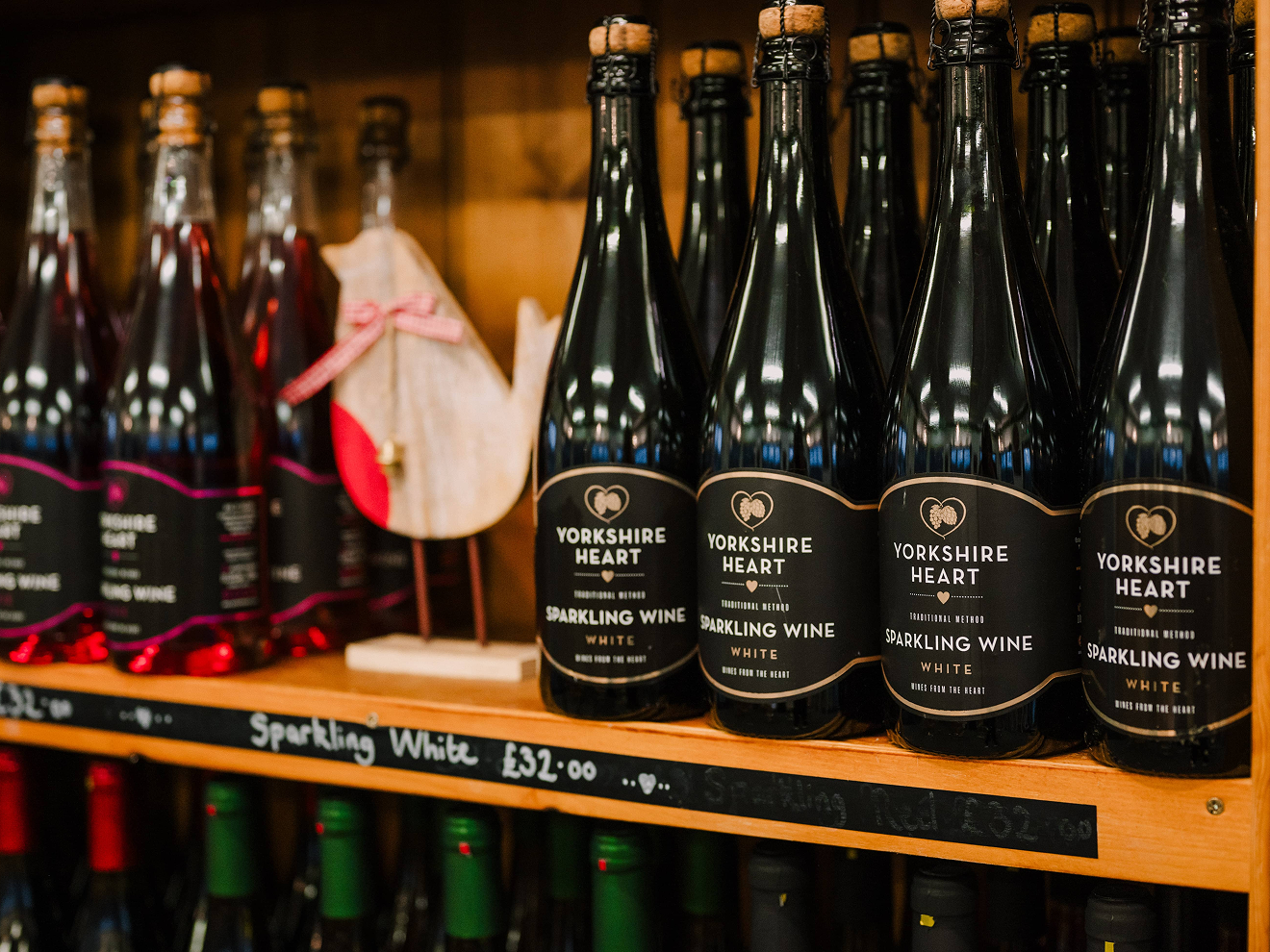
If you’d like to taste what cool-climate Yorkshire sparkling brings to all this, our Sparkling White is a good place to start, made the traditional way just outside York.
Still whites: where England has quietly arrived
France produces a staggering range of still white wine: the steely minerality of Chablis, the zip of Sancerre, the perfumed Riesling and Gewürztraminer of Alsace, and the Burgundian Chardonnay that the rest of the world still measures itself against.
English still whites have arrived more recently, but they have arrived. We are strongest in the cool-climate, aromatic, dry style. The grapes to know are Bacchus (often called England’s answer to Sauvignon Blanc), Solaris (tropical fruit and properly cold-hardy), Ortega (floral and gently off-dry) and Seyval Blanc (citrus-fresh, often used for sparkling).
Where France still wins: the depth and complexity of a great white Burgundy, a fine Meursault or a Chablis Premier Cru, remains out of reach for English wine, and probably will for a while. France also simply offers more variety, region after region of it. That is decades of head start.
Where England has caught up: at similar price points, aromatic Bacchus and Solaris whites now hold their own and often outshine their French equivalents for sheer freshness. The vote of confidence that turned heads was Jackson Family Wines, a major American producer, investing in English Chardonnay. Serious people are betting on this.
Our own cool-climate whites tell the same story in miniature. Our Latimer White and Eleanor White lean into that fresh, aromatic style, and our Ortega is floral and softly off-dry, made for the same moments as an Alsace Pinot Gris. You can find them on our white wine page.
Still reds: the honest bit
This is where we tell the truth, because pretending otherwise would cost us your trust.
France’s reds are a different league. Bordeaux blends, Burgundian Pinot Noir, Rhône Syrah and Beaujolais Gamay all benefit from warmer summers, deeper history and a settled style. England’s reds are still finding their feet. Our cool climate makes it genuinely hard to ripen full-bodied reds, and even our most successful red grapes, Pinot Noir, Rondo and Dornfelder, are gentle by Bordeaux standards.
What English reds do well is the lighter, fresher, lower-alcohol end of the spectrum. Pinot Noir in particular is showing real promise. The wine writer Ruth Spivey has praised English Pinot Noir for its purity and drinkability, and producers like Tillingham are making the case bottle by bottle.
So, plainly: if you want a big Bordeaux for a winter roast, France is still your answer. If you want a lighter Pinot for a summer dinner, English Pinot is now a real option. Our own Pinot Noir is made in that lighter, fresher English style, and our L.F.R. (Light Fruity Red) is the easy-drinking everyday option. If you usually drink Burgundy, you may well enjoy them. If you usually drink Châteauneuf-du-Pape, you probably won’t, and we would rather tell you that now.
Rosé, dessert wine, and the rest
A quick tour of the smaller categories.
Rosé. Provence still rules dry still rosé, globally and comfortably. But English sparkling rosés are doing now what English sparkling whites did fifteen years ago: closing the gap fast. Our Kathleen Vintage Sparkling Rosé sits firmly in that rising category.
Dessert wine. France has the great sweet wines of Sauternes, Monbazillac and Alsace. England makes less, but what it makes is respectable, often from Solaris. Our Solara Dessert Wine is a good example of the style.
Orange and natural wine. This is a newer front, and England has a small but growing scene. We make a Solaris Orange Wine and a Solaris Natural Wine for the curious.
Price and value
The honest answer to a question every reader has.
Cheap French wine, the Vin de Pays end of the shelf, is genuinely cheap and often very good for the money. Cheap English wine, on the other hand, essentially does not exist. UK land, labour and duty make a well-made bottle under about £12 close to impossible. That is the trade-off.
At £15 to £30, English and French wines compete on roughly level terms. Above £40, English sparkling now consistently delivers what Champagne offers at the same price, and sometimes more. The market seems to agree: Champagne shipments to the UK fell 12.7 per cent in 2024, part of a wider shift in what British drinkers are reaching for.
Where to start: an English wine for your French favourite
If all this has you thinking “right, where do I actually begin?”, here is the practical bit. Match what you already love to an English equivalent.
- If you love Champagne, try our Sparkling White. Same method, fresher style, made just outside York.
- If you love rosé Champagne, try our Kathleen Vintage Sparkling Rosé.
- If you love Burgundian Pinot Noir, try our Yorkshire Pinot Noir. Lighter than Burgundy, but with a similar elegance.
- If you love Sancerre or Loire Sauvignon Blanc, try an English Bacchus, or our Latimer White as a fresh cousin.
- If you love Alsace Pinot Gris or Gewürztraminer, try our Ortega. Floral, gently off-dry, built for the same kind of evening.
- If you love Sauternes, try our Solara Dessert Wine.
The verdict
The honest answer is that French wine is older, broader and still the most varied and prestigious wine culture on earth. But English wine has earned its place at the table, and not as a curiosity. In sparkling, the gap has all but closed, and in plenty of blind tastings it has reversed. In aromatic whites, English is now genuinely competitive. In full-bodied reds, France still leads, and English Pinot is the one to watch.
The smart move for a wine drinker is not to pick a side. It is to drink both, and to give English wine the serious tasting it has now earned.
If you fancy doing exactly that, you can browse our wines or come and taste them where they are made on a vineyard tour and tasting.
English vs French wine FAQs
Is English wine as good as French wine?
It depends on the category. For sparkling, yes, English wine now routinely matches and sometimes beats Champagne in blind tastings. For aromatic dry whites, it is catching up fast. For full-bodied reds, France still leads comfortably.
Why is English wine so expensive?
There is almost no cheap English wine, because the cost of UK land, labour and duty, combined with small production scale, makes a sub-£12 bottle very hard to make well. The value sits in the £15 and upwards range, where English wine competes strongly.
What’s the difference between English sparkling wine and Champagne?
They use the same traditional method and often the same grapes (Chardonnay, Pinot Noir, Pinot Meunier). English sparkling tends to be fresher and zestier; Champagne tends to be richer, with more of that bready, biscuity character from long ageing on the lees.
Is Yorkshire wine actually any good?
Yes. Our cooler climate and clay soils make Yorkshire wine different from the chalk-grown wines of the south, but with the same cool-climate freshness and intensity. Slow ripening is the secret.
What’s the best English wine to start with?
For sparkling, a good traditional-method Brut. For still white, a Bacchus or a Solaris will show you the fresh, aromatic English style at its best.
Will English wine ever rival Bordeaux?
For full-bodied reds, unlikely, given the climate. For elegant, lighter Pinot Noir, it is a realistic possibility within a decade.
Did the English really invent sparkling wine?
The method, yes. Christopher Merret described it to the Royal Society in 1662, around thirty years before Dom Pérignon was working at Hautvillers. England also made the strong glass bottles that made bottle-fermented sparkling wine possible.
Is climate change helping English wine?
In the short term, yes, by making ripening more reliable. But the same warming is hurting Champagne through drought and crop losses, so it is better understood as a long-term shift in regional advantage than an unqualified good.

Sign up for news and special offers
Subscribe to our newsletter to be the first to hear about exciting news, updates, events and receive exclusive offers.